Caboose Art Wall
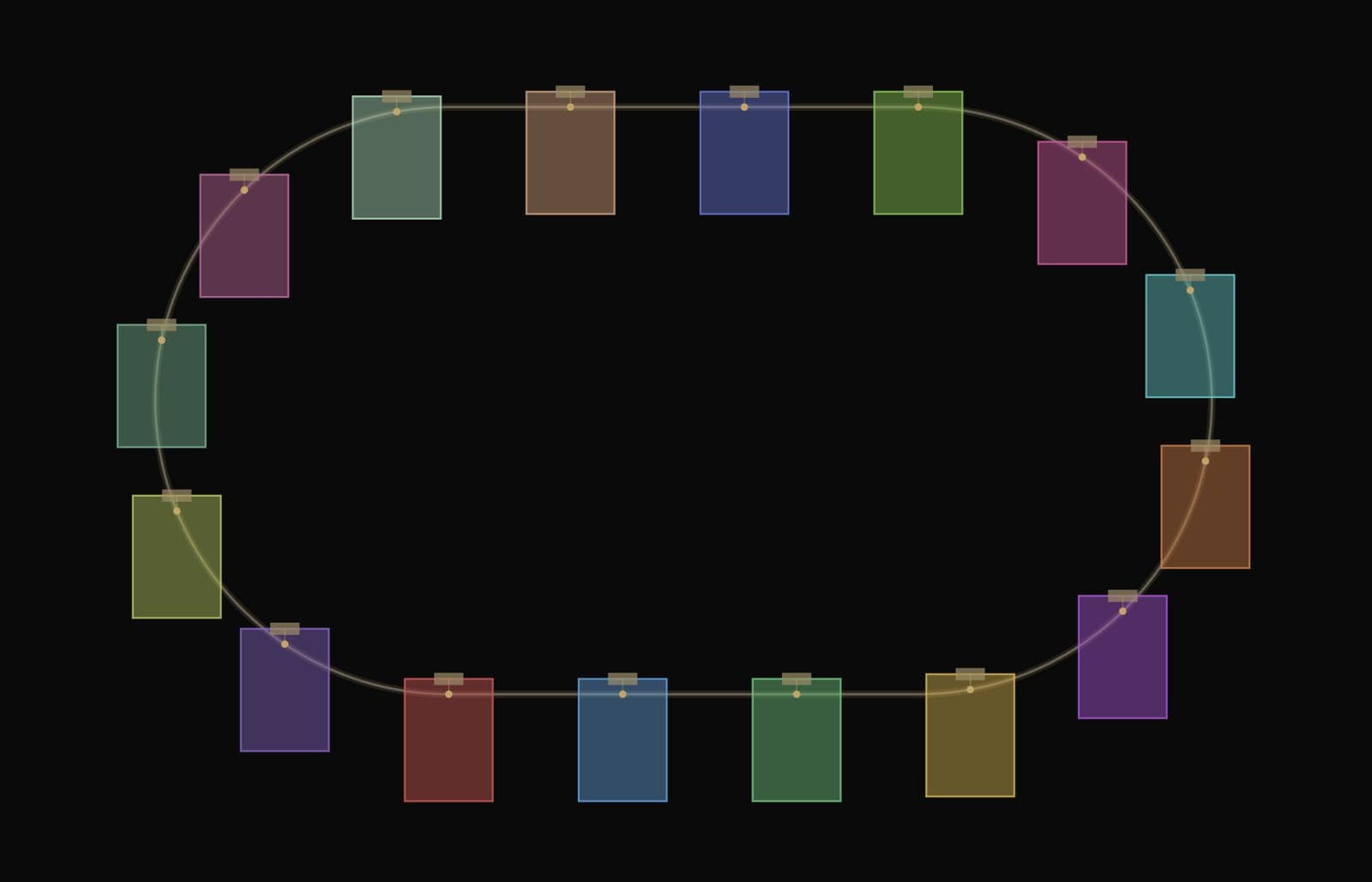
In progressA train of clipboards that crawls around a loop on the wall, so every drawing my son makes gets its turn at eye level. The track is hidden. The mechanism is hidden. All you see is the art moving.
Why It Exists
My son loves to draw and colour. A lot of days, instead of taking his nap, he sits quietly and colours instead. We've piled up hundreds of pages of it.
Displaying it is the problem. The fridge holds one piece at a time, maybe two, so showing anything means constantly deciding what comes down. I wanted something that shows a lot of his work at once and makes swapping a drawing as easy as unclipping one and clipping in the next. A living art wall.
That could have been a row of clipboards on a rail. Then I thought: why not put motors on it? And a smart controller, and a battery, and Bluetooth, and an app to drive it. That's what we do here.
How It Works
It's a monorail pinch drive. The track is a spine with a toothed rack on the top and bottom edges. The engine wraps around it, and two geared motors pinch the spine from above and below. Turn the motors and the engine climbs along the track, towing the carriages behind it.
The teeth face the drywall. From the room, the track is just a clean rail. Every clipboard hangs level beneath its carriage on a bearing, so it stays upright no matter where the loop turns.
The engine rotates with the track through the curves, but the battery and clipboard below it don't. That would twist the wires into a rope within a lap, so there's a six-circuit slip ring in the middle. It carries raw battery and nothing else: three circuits paralleled for positive, three for negative. Regulators, motor drivers and the microcontroller all ride on the engine side. No logic crosses the joint, so nothing can glitch across it.
The Hard Parts
Corners. A geared drive going around a bend has a phase problem. The outer rack is longer than the inner one, so when you come out of a curve the teeth on top and bottom no longer line up with the motor gears. The usual fix is a pile of hand-tuned shift constants.
Instead, the arc radius is tuned so the outer rack is a whole number of teeth, and the inner rack goes bald through the curve. When the engine comes back onto the straight, the phase is correct by construction, for any shape of path. No constants, no ramp pieces. The trapezoid teeth chamfer themselves back into mesh.
The bind. The first printed curve jammed. Same spot, every time, and only on curves. Everyone's first instinct is the teeth. It wasn't the teeth.
The seam between track pieces was pinching the connecting shaft as it swept through the bend. The fix was widening the slot by 0.1 mm per side. Two tenths of a millimetre, and it rolls clean.
The change is small enough that the straights I'd already printed didn't need reprinting. Old straights and new arcs run together fine.
Planning the Wall
Before cutting anything I built a layout simulator: set the loop size, corner radius, clipboard count and size, and it animates the train and flags any boards that collide on the curves. I settled on 16. There's an option to fill the middle of the oval with a static grid, so the whole wall becomes the gallery.
Speed was the other call. The motors could lap the wall in under forty seconds, but that reads as a machine. Around 80 seconds a lap reads as art. Running slow also keeps the motors in the fat part of their torque curve, so the slow version is the stronger one too.
Where It Stands
It's not done. The track, gears, motor housings and hangers are all validated in plastic, and the curve bind is solved. The electronics are half-wired and the firmware isn't written yet.
The plan for control is deliberately low-tech on the outside. The XIAO has a microphone on board, so you clap to start it. For anything fancier, the app is a single-file Web Bluetooth page you open on your phone. Nothing to install, no buttons on the wall. After that: bench test, production prints, and getting it up on the wall.