Warble
Shipped (V1)A cordless phone for my four-year-old. Tap a face, call a person. No camera, no apps, no browser. It sits in a dock on the kitchen counter and rings like the phones I grew up with.
Why It Exists
My kid wanted to call people. The grandparents, mostly. The options were handing over my phone — which is a slot machine with a dialer attached — or buying a "kid phone" that is really a stripped-down smartphone with a tracking subscription.
Neither teaches the thing I actually wanted to teach: how to talk on the phone. Ringing someone, waiting, saying hello, holding a conversation with a voice and no face. That's a skill, and most kids now skip it entirely.
So I built the phone I wanted them to have. It can do exactly one thing, and that one thing is the point.
"The phone that can't do anything" isn't the limitation. It's the feature. The screen exists to end an interaction — find the face, place the call — never to extend one.
How It Works
The brain is an ESP32-S3 dev board with a 2.4" colour touchscreen. The home screen shows the time and one line: tap to see everyone. Everyone is a grid of photo avatars. Tap one and it places a real call over SIP — to an actual phone number, not an app.
The rules don't live on the phone. A small web dashboard answers every inbound and outbound call and decides whether it goes through. Only whitelisted numbers can ring in, only whitelisted numbers can be dialled out. Quiet hours are enforced there too, so they work even if the phone is off. A kid can't tamper their way around a policy that isn't on the device.
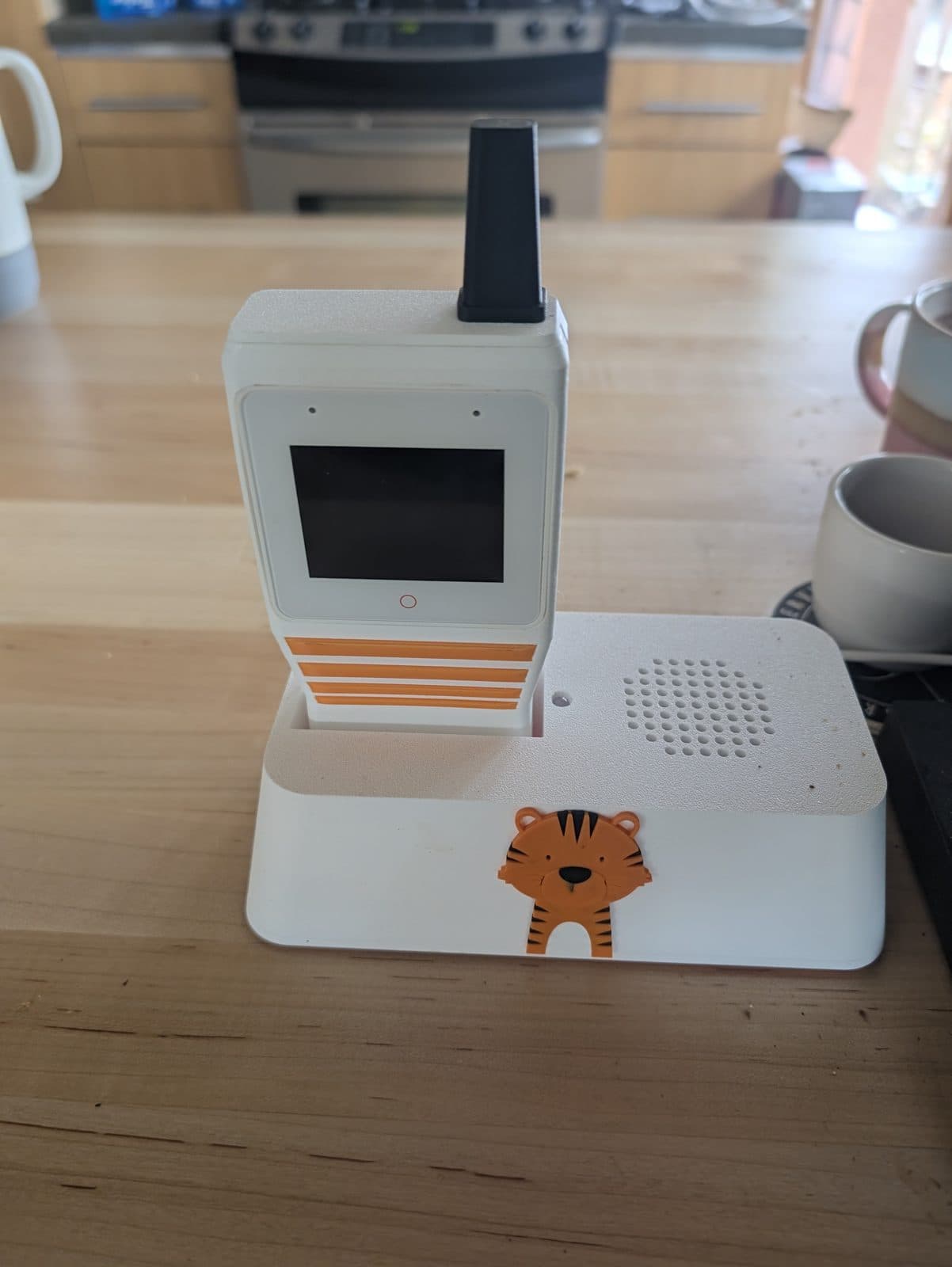
The dock is doing more than charging. It has its own 2" speaker wired through the pogo pins, so a docked handset rings out loud across the room. Lift it and the earpiece takes over. The earpiece has a series resistor that caps its power in hardware. It's ear-safe by construction, not by a volume setting. The handset docks screen-out, so you can see who's calling while it rings.
The housing is printed in two pieces plus a press-fit antenna, with no supports. The screen is on the front and the talk side is on the back. Your cheek lands on blank plastic during a call, so there are no phantom screen taps mid-conversation. The orange grip stripes and the tiger on the dock are TPU inlays. The tiger is my kid's theme on this unit — colour, emblem and antenna are meant to be swapped per phone.
Gallery
Where It Stands
V1 is built, sealed and in daily use. Calls, voicemail, contacts, battery readout and the charge light all work. It's a prototype and it shows in places. The housing is glued shut, and the cell tops out around half charge, which I've decided I can live with on a one-off. The remaining work is software.
V2 is split into two lines. The KID model is on a smaller, cheaper board. The FAMILY model is a larger-screen, dock-resident house phone for adults — a landline where every ring is someone you actually want to hear from. The first KID units are going to a nephew and a niece this Christmas, plus a neighbour who became customer number one.